

Perfecting Your Form: Heel Raised Squats
When looking to refine your lower body mechanics, heel raised squats are an excellent variation to incorporate into your routine. By elevating the heels on plates, this setup alters your body’s geometry to target specific muscle groups and accommodate different mobility levels.
In our latest Gym Tip, we demonstrate how to perform heel raised squats to improve your range of motion and dial in your posture.
Why Do Heel Raised Squats?
Elevating the heels primarily allows the knees to travel further forward during the descent. This subtle shift in mechanics is an excellent workaround if you are currently limited by ankle mobility, allowing you to bypass that restriction while still getting deep into the movement. This setup achieves two main things: it activates a little bit more of the quadriceps and helps you get a full range of motion in the hips down below the knees.
The Setup & Execution
Whether you are working on your squat depth or trying to keep your torso more upright, proper setup is critical:
-
The Foundation: Stand with your heels resting securely on top of weight plates.
-
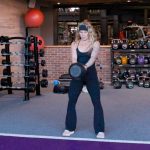
The Weight Placement: Hold your weight up in front of your chest. Having the weight positioned here allows for a more vertical torso angle. If you place a bar on your back or hold a weight down in front of your legs, it pulls your body further forward, which challenges the glutes and hamstrings instead of targeting the quads.
-
The Movement: Sit into the squat while keeping a good range of motion. Keep your chest up, eyes looking forward, and ensure your back remains nice and flat.
Stability & Footwear Considerations
While resting your heels on weight plates is a great training tool for lighter weights or learning the movement, it inherently introduces a risk of instability since your foot isn’t fully planted on a flat surface. If you are going to transition into heavy back squats, you should strongly consider wearing proper weightlifting shoes. These shoes feature a hard, elevated heel that serves the exact same mechanical purpose as the plates, but provides a much safer, firmly planted foundation to drive weight upward.
Common Posture Mistakes to Avoid
To ensure you are squatting safely, pay close attention to your body positioning. Avoid letting your head drop down and forward, which results in lost posture. When you lose that posture, you miss out on the forward angle at the knee, and more importantly, your lower back drops into a poor position that might cause injury.
There are a lot of considerations when choosing which squat variation is right for you. If you want to learn more about exactly what to do and why it benefits your specific body mechanics, you should check out a Big Sky coach!
By incorporating heel raised squats with a focus on strict form, you can improve your mobility and refine your lower body mechanics.
Check out another Gym Tip: Better Full Body Conditioning – Lateral Barbell Burpees
Click here to sign up for our FREE 5 Session Personal Training Experience !
Members and Non-Members Welcome!
Better workouts, better results.
See you at Big Sky!